


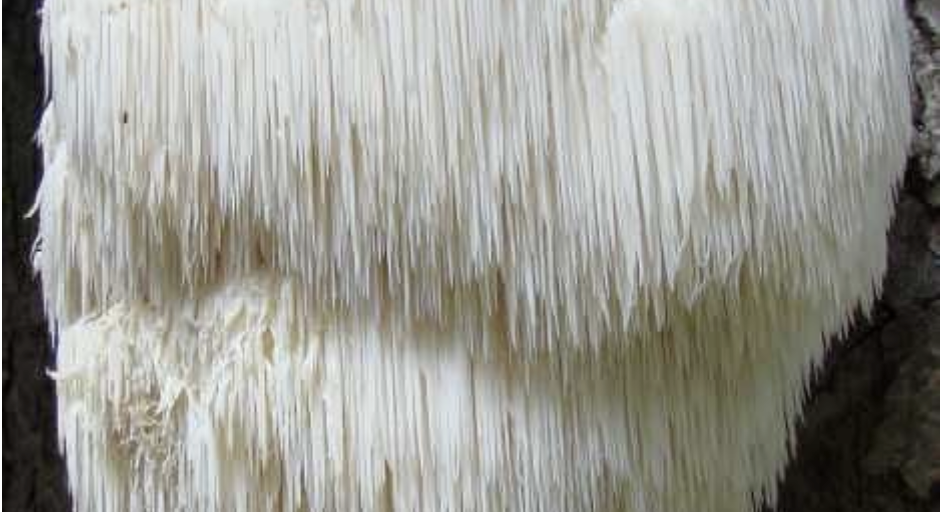
Few mushrooms stop you in your tracks quite like lion’s mane. It doesn’t have a cap or gills. Instead it hangs from the side of a tree like a frozen waterfall of soft white icicles. Once you’ve seen one in the wild, you won’t forget it.
A little history
Lion’s mane (Hericium erinaceus) has been part of traditional Chinese practice for centuries. Its Chinese name, hou tou gu, means “monkey head mushroom,” and it was valued both as food and in traditional wellness. Stories tell of monks who prized it as part of their practice of focus and meditation. Today it’s a favorite of chefs and a subject of ongoing scientific interest.
What is lion’s mane?
You’ll know it by its long, white, cascading spines, which really do look like a lion’s mane. The texture is tender and a little stringy, and the flavor is often compared to crab or lobster, somewhere between seafood and poultry. It grows on hardwoods, especially oak, beech and maple, and likes temperate climates.
Where to find and forage it
In the wild, look for lion’s mane on dead or dying hardwood trees and fallen logs, usually from late summer into fall across North America, Europe and parts of Asia. It often grows high up on a trunk, so bring patience and a good eye.
As with any wild mushroom, never eat something you can’t identify with complete confidence. Go out with an experienced forager or a local mycological society until you know it well. If foraging isn’t an option, lion’s mane is now widely cultivated and easy to find fresh at farmers’ markets, or dried and powdered.
Why people are curious about it
Lion’s mane is one of the most studied functional mushrooms, and researchers continue to look at the compounds it contains, including hericenones and erinacines. Many people like to include it in focus-minded morning routines. The research is still early, so think of it as a fascinating mushroom to get to know rather than a fix for anything.
Cooking with lion’s mane
- Sautéed: slice it and cook it in butter or oil until golden for a rich, meaty bite.
- In soups and stews: it soaks up broth and adds body.
- As a seafood stand-in: shred it for “crab” cakes or pull it apart like chicken.
- In stir-fries: pair it with crisp vegetables and a simple sauce.
Recipe 1: Simple sautéed lion’s mane
Ingredients
- 1 lb fresh lion’s mane, sliced
- 2 tbsp olive oil
- 2 garlic cloves, minced
- 1 tbsp fresh thyme or rosemary
- Salt and pepper
Method
- Heat the oil in a skillet over medium heat.
- Add the garlic and cook for 1 minute, until fragrant.
- Add the lion’s mane and cook, stirring now and then, until golden and tender, 5 to 7 minutes.
- Season with salt, pepper and herbs. Serve warm as a side or on toast.
Recipe 2: Creamy lion’s mane soup
Ingredients
- 1 lb lion’s mane, chopped
- 1 onion, chopped
- 2 carrots, diced
- 3 garlic cloves, minced
- 4 cups vegetable broth
- 1 cup coconut milk
- 2 tbsp olive oil
- Salt and pepper
Method
- Warm the oil in a large pot over medium heat. Cook the onion, carrots and garlic until soft.
- Add the lion’s mane and cook for 5 more minutes.
- Pour in the broth, bring to a boil, then simmer for 20 minutes.
- Stir in the coconut milk and blend until smooth. Season and serve hot.
Recipe 3: Lion’s mane stir-fry
Ingredients
- 1 lb fresh lion’s mane, sliced
- 1 bell pepper, sliced
- 1 cup snap peas
- 2 tbsp soy sauce
- 1 tbsp sesame oil
- 1 tbsp grated ginger
- 2 garlic cloves, minced
- Cooked rice or noodles
Method
- Heat the sesame oil in a large pan over medium-high heat. Add the garlic and ginger and cook for 1 minute.
- Add the lion’s mane and stir-fry for 5 minutes.
- Add the pepper and snap peas and cook for 3 to 4 minutes, until tender-crisp.
- Stir in the soy sauce, cook 2 more minutes, and serve over rice or noodles.
Whether you find it on a fallen oak or at the market, lion’s mane is a mushroom worth getting to know.
These statements have not been evaluated by the Food and Drug Administration. This product is not intended to diagnose, treat, cure, or prevent any disease.